
McGill University
Cellular Microenvironment Design Lab
Wong Building, Rue University, Montreal, QC, Canada
Overview
Cells and tissues exist in complex microenvironments, in which they are subject to a variety of physical forces and chemical cues. These microenvironmental signals regulate cell function, and are hence crucially important to consider when designing new therapies. However, replicating these signals in conventional cell culture systems is often challenging, particularly when studying dynamic tissues undergoing developmental or disease processes. Our lab designs and builds microtechnologies to probe the complex relationships between mechanics, materials, and biological function in engineered tissues. By creating precision tissue engineering tools and cell culture systems, we gain insight into the physical mechanisms underlying cardiovascular, cancer and respiratory diseases; and aim to apply this knowledge in designing the next generation of therapeutic discovery platforms.
Mechanical forces in biological systems
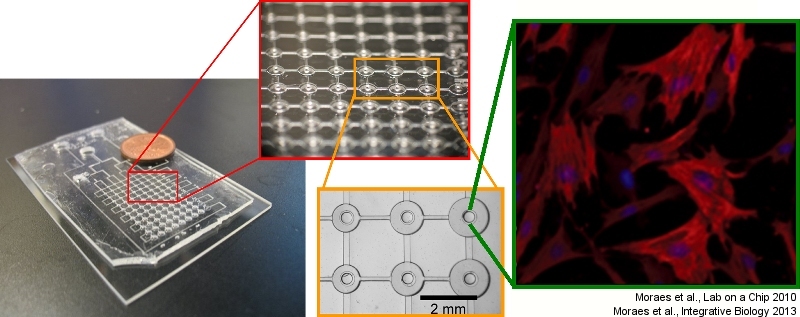
Cells are now recognized as hubs of mechanical activity: responding to external mechanical signals, they generate forces, restructure the surrounding matrix, and coordinate the self-assembly of tissues and organs. Thinking of living tissues as being highly responsive, adaptable, and robust structures suggests unique opportunities to understand, manipulate, and learn from biological systems. To address some of the key challenges in understanding the role mechanical forces play in biological systems, we have developed novel microtechnologies capable of screening cellular response to cyclic mechanical loads in a high-throughput manner. We have also designed techniques to measure dynamic mechanical forces in three-dimensional developing tissues, and are currently applying these platform technologies to study disease progression in cardiovascular and cancer systems.
Microengineered biomaterials
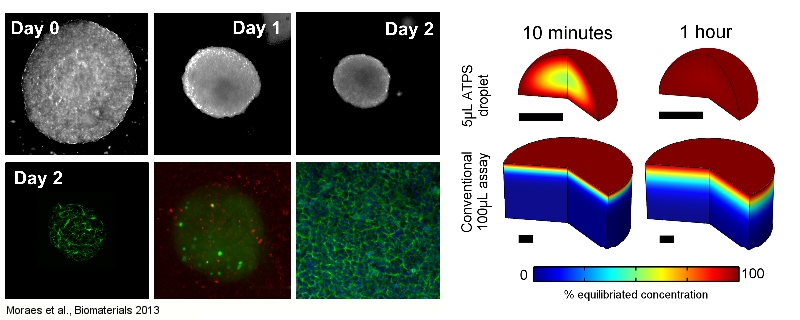
The rational design of biomaterials to direct cell function is a cornerstone of tissue engineering and regenerative medicine. Scientists are currently able to design biomaterials at the nano- (molecular) scale, and at the macro-scales to achieve these goals. We focus on designing technologies to control biomaterials at the interface of these two size regimes, and leverage the unique properties of such microengineered systems to address fundamental biological questions. In this area, we are developing novel and versatile techniques to study cells in three-dimensional environments, particularly in terms of controlling and manipulating the fibrous nature of 3D hydrogel environments at the single-cell level, and designing microscale tissues to circumvent transport limitations in conventional culture systems. We also design novel ‘smart’ biomaterial platforms that enable culture of cells in highly dynamic, but precisely-controlled microenvironments. These studies typically require the development of novel tissue engineering and biofabrication technologies in combination with fundamental engineering analyses, and can be of critical importance in tissue engineering applications.
Next-generation drug discovery systems
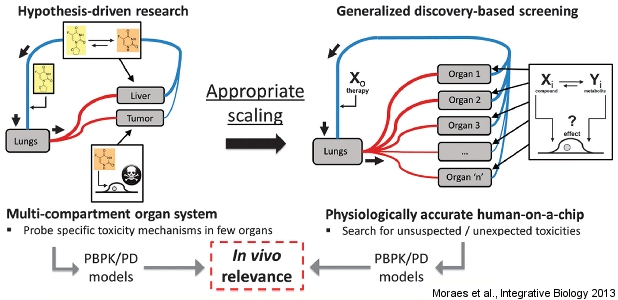
Our ultimate goal is to create a complete miniaturized version of human physiology in a microfabricated format. This ‘human-on-a-chip’ concept has generated tremendous interest and excitement in the field, as it would enable highly realistic screening of new therapies, prior to expensive animal testing and lengthy human clinical trials. In working towards this, we are exploring the “design rules” necessary to develop complete biological discovery systems in which multiple cell types can be cultured in realistic proportions, in combination with integrated analytical techniques, to provide real-time and high-resolution feedback on physiological state.
Contact the facility
Talk to the team about your research, access, or a visit.
Find us
McGill University
Wong Building, Rue University, Montreal, QC, Canada