ServiceAvailable
Cancer Genomics Analysis
Faculty of Medicine and Health Sciences
Core Facility
McGill University
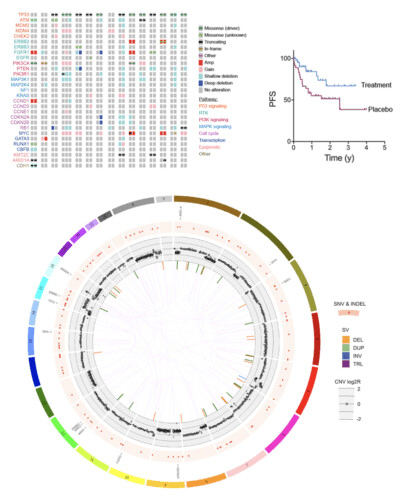
C3G provides comprehensive cancer genomics analysis by sequencing DNA from both tumor and healthy cells, enabling the discovery of novel cancer-associated variants. Their pipeline is designed to detect a wide range of genomic alterations, including single nucleotide variants (SNVs), insertions/deletions (INDELs), structural variants (SVs), and copy number alterations (CNAs).
To ensure high-confidence variant detection, C3G employs a multi-caller approach for variant calling in matched tumor-normal pairs. For SNVs and INDELs, the Bcbio.variations ensemble method is used, integrating results from GATK MuTect2, VarDict, Strelka2, and VarScan2, selecting only variants identified by at least two of these tools. Similarly, structural variants (SVs) are detected using multiple callers, including DELLY, LUMPY, WHAM, and SvABA, with results combined through MetaSV to improve reliability.
For copy number variation (CNV) analysis, CNVkit is used to infer chromosomal and gene-specific amplification or deletion events by analyzing sequencing coverage. C3G also integrates specialized cancer-specific tools to estimate tumor purity and tumor ploidy, providing a comprehensive view of tumor composition.
Each list of detected variants is fully annotated with information on genes and transcripts affected, genomic location, functional consequences, and known clinical relevance, leveraging databases such as ClinVar and CIViC.
C3G’s tumor-normal WGS pipeline is also applicable to patient-derived xenograft (PDX) and mouse models, enabling translational cancer research and preclinical studies. Their advanced analytical framework ensures researchers gain accurate, reproducible, and clinically relevant insights from cancer sequencing data.

Canadian Centre for Computational Genomics (C3G)
Faculty of Medicine and Health Sciences
Shared research facility offering instruments, services and expertise.
GB
Guillaume Bourque
Canadian Centre for Computational Genomics (C3G) · McGill UniversityServiceAvailable
Cancer Genomics Analysis
Faculty of Medicine and Health Sciences
Core Facility
McGill University
C3G provides comprehensive cancer genomics analysis by sequencing DNA from both tumor and healthy cells, enabling the discovery of novel cancer-associated variants. Their pipeline is designed to detect a wide range of genomic alterations, including single nucleotide variants (SNVs), insertions/deletions (INDELs), structural variants (SVs), and copy number alterations (CNAs).
To ensure high-confidence variant detection, C3G employs a multi-caller approach for variant calling in matched tumor-normal pairs. For SNVs and INDELs, the Bcbio.variations ensemble method is used, integrating results from GATK MuTect2, VarDict, Strelka2, and VarScan2, selecting only variants identified by at least two of these tools. Similarly, structural variants (SVs) are detected using multiple callers, including DELLY, LUMPY, WHAM, and SvABA, with results combined through MetaSV to improve reliability.
For copy number variation (CNV) analysis, CNVkit is used to infer chromosomal and gene-specific amplification or deletion events by analyzing sequencing coverage. C3G also integrates specialized cancer-specific tools to estimate tumor purity and tumor ploidy, providing a comprehensive view of tumor composition.
Each list of detected variants is fully annotated with information on genes and transcripts affected, genomic location, functional consequences, and known clinical relevance, leveraging databases such as ClinVar and CIViC.
C3G’s tumor-normal WGS pipeline is also applicable to patient-derived xenograft (PDX) and mouse models, enabling translational cancer research and preclinical studies. Their advanced analytical framework ensures researchers gain accurate, reproducible, and clinically relevant insights from cancer sequencing data.
Canadian Centre for Computational Genomics (C3G)
Faculty of Medicine and Health Sciences
Shared research facility offering instruments, services and expertise.
GB
Guillaume Bourque
Canadian Centre for Computational Genomics (C3G) · McGill UniversityYou might also like
Discover more resources that could support your research