ServiceAvailable
Single-Cell RNA-Seq (scRNA-Seq) Analysis
Faculty of Medicine and Health Sciences
Core Facility
McGill University
Single-cell RNA sequencing (scRNA-Seq) is a powerful technique for measuring genome-wide expression profiles at the individual cell level. This approach enables researchers to explore biological questions where cell-specific transcriptomic changes are critical, such as identifying distinct cell types and analyzing the heterogeneity of cellular responses. Unlike bulk RNA-Seq, scRNA-Seq requires specialized data processing strategies to account for the unique challenges of single-cell analysis.
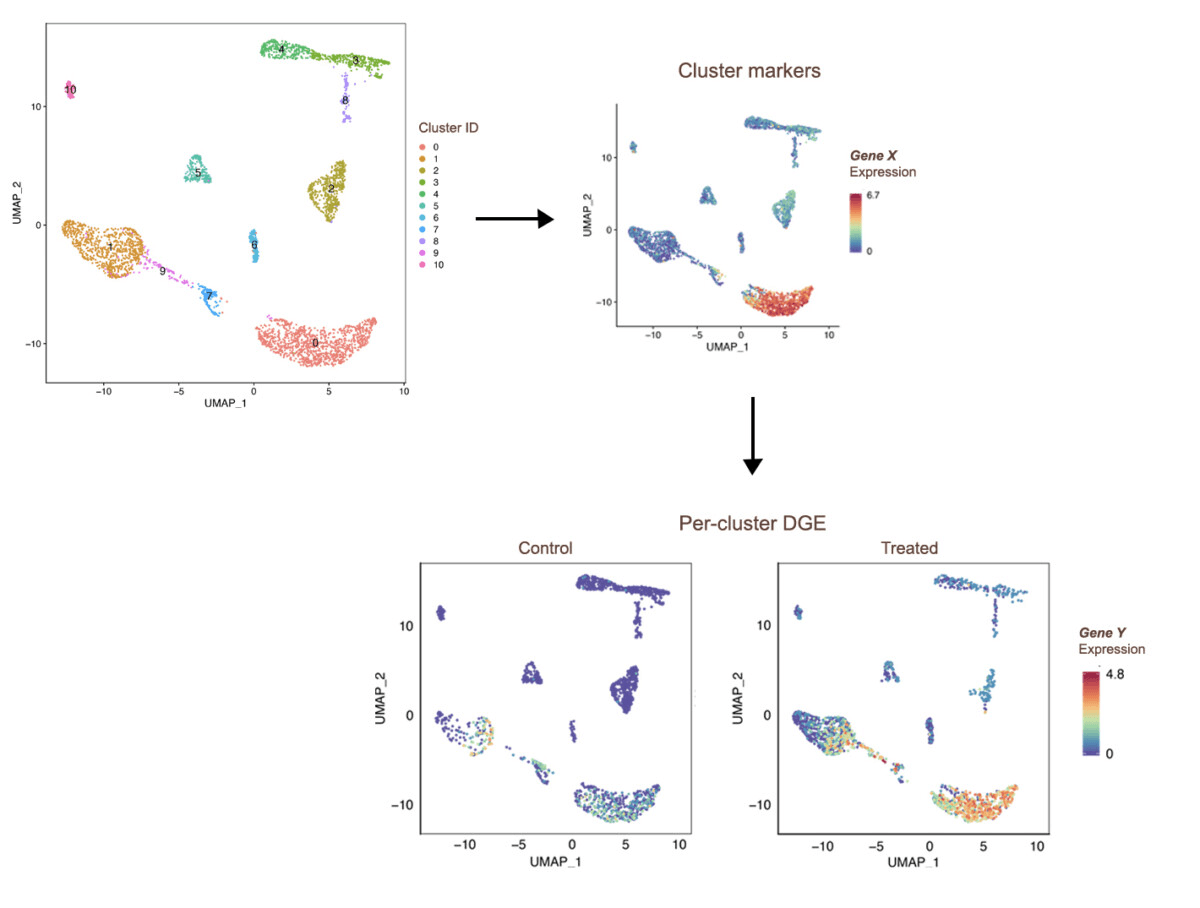
C3G’s scRNA-Seq pipeline utilizes Cell Ranger (10X Genomics) to process 10X single-cell data, generating high-quality count matrices for downstream analysis. The Seurat R package is used for in-depth scRNA-Seq analysis, including quality control assessments, data exploration, clustering, and cell-type identification. Additionally, differential expression analysis is performed on a per-cluster basis to identify key transcriptomic differences between cell populations.
To investigate dynamic cellular processes, trajectory analysis is conducted using Monocle, which reveals continuous and evolving cellular identities over time. C3G’s pipeline is highly adaptable and can process single-cell data generated from various platforms, ensuring flexibility across different experimental designs.

Canadian Centre for Computational Genomics (C3G)
Faculty of Medicine and Health Sciences
Shared research facility offering instruments, services and expertise.
GB
Guillaume Bourque
Canadian Centre for Computational Genomics (C3G) · McGill UniversityServiceAvailable
Single-Cell RNA-Seq (scRNA-Seq) Analysis
Faculty of Medicine and Health Sciences
Core Facility
McGill University
Single-cell RNA sequencing (scRNA-Seq) is a powerful technique for measuring genome-wide expression profiles at the individual cell level. This approach enables researchers to explore biological questions where cell-specific transcriptomic changes are critical, such as identifying distinct cell types and analyzing the heterogeneity of cellular responses. Unlike bulk RNA-Seq, scRNA-Seq requires specialized data processing strategies to account for the unique challenges of single-cell analysis.
C3G’s scRNA-Seq pipeline utilizes Cell Ranger (10X Genomics) to process 10X single-cell data, generating high-quality count matrices for downstream analysis. The Seurat R package is used for in-depth scRNA-Seq analysis, including quality control assessments, data exploration, clustering, and cell-type identification. Additionally, differential expression analysis is performed on a per-cluster basis to identify key transcriptomic differences between cell populations.
To investigate dynamic cellular processes, trajectory analysis is conducted using Monocle, which reveals continuous and evolving cellular identities over time. C3G’s pipeline is highly adaptable and can process single-cell data generated from various platforms, ensuring flexibility across different experimental designs.
Canadian Centre for Computational Genomics (C3G)
Faculty of Medicine and Health Sciences
Shared research facility offering instruments, services and expertise.
GB
Guillaume Bourque
Canadian Centre for Computational Genomics (C3G) · McGill UniversityYou might also like
Discover more resources that could support your research