Digital AssetAvailable
MNI-FTD Templates: Unbiased Average Templates of Frontotemporal Dementia Variants
Quote on request
Faculty of Medicine and Health Sciences
Biomedical Engineering
McGill University
Standard anatomical templates are widely used in human neuroimaging processing pipelines to facilitate group level analyses and comparisons across different subjects and populations. The MNI-ICBM152 template is the most commonly used standard template, representing an average of 152 healthy young adult brains. However, in patients with neurodegenerative diseases such as frontotemporal dementia (FTD), the high levels of atrophy lead to significant differences between the brain shape of the individuals and the MNI-ICBM152 template. Such differences might inevitably lead to registration errors or subtle biases in downstream analyses and results. Disease-specific templates are therefore desirable to reflect the anatomical characteristics of the populations of interest and to reduce potential registration errors when processing data from such populations.
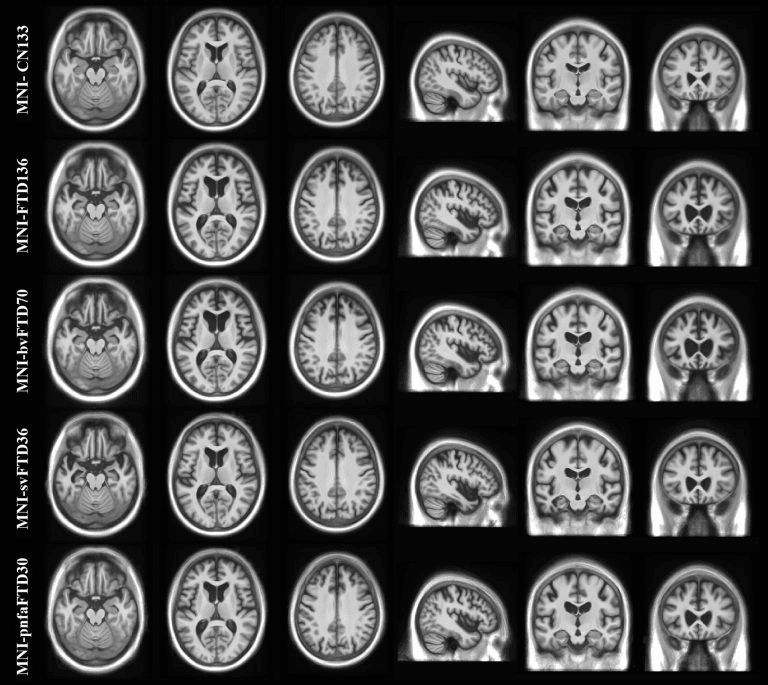
Here, we present MNI-FTD136, MNI-bvFTD70, MNI-svFTD36, and MNI-pnfaFTD30, four unbiased average templates of 136 FTD patients, 70 behavioural variant (bv), 36 semantic variant (sv), and 30 progressive nonfluent aphasia (pnfa) variant FTD patients as well as a corresponding age matched average template of 133 healthy controls (MNI-CN133), along with probabilistic tissue maps for each template. The public availability of these templates will facilitate analyses of FTD cohorts and enable comparisons between different studies in a common standardized space appropriate to FTD populations.

NIST Lab
Faculty of Medicine and Health Sciences
Research lab focused on advancing scientific knowledge and innovation.
LC
Louis Collins
NIST Lab · McGill UniversityDigital AssetAvailable
MNI-FTD Templates: Unbiased Average Templates of Frontotemporal Dementia Variants
Quote on request
Faculty of Medicine and Health Sciences
Biomedical Engineering
McGill University
Standard anatomical templates are widely used in human neuroimaging processing pipelines to facilitate group level analyses and comparisons across different subjects and populations. The MNI-ICBM152 template is the most commonly used standard template, representing an average of 152 healthy young adult brains. However, in patients with neurodegenerative diseases such as frontotemporal dementia (FTD), the high levels of atrophy lead to significant differences between the brain shape of the individuals and the MNI-ICBM152 template. Such differences might inevitably lead to registration errors or subtle biases in downstream analyses and results. Disease-specific templates are therefore desirable to reflect the anatomical characteristics of the populations of interest and to reduce potential registration errors when processing data from such populations.
Here, we present MNI-FTD136, MNI-bvFTD70, MNI-svFTD36, and MNI-pnfaFTD30, four unbiased average templates of 136 FTD patients, 70 behavioural variant (bv), 36 semantic variant (sv), and 30 progressive nonfluent aphasia (pnfa) variant FTD patients as well as a corresponding age matched average template of 133 healthy controls (MNI-CN133), along with probabilistic tissue maps for each template. The public availability of these templates will facilitate analyses of FTD cohorts and enable comparisons between different studies in a common standardized space appropriate to FTD populations.
NIST Lab
Faculty of Medicine and Health Sciences
Research lab focused on advancing scientific knowledge and innovation.
LC
Louis Collins
NIST Lab · McGill UniversityYou might also like
Discover more resources that could support your research