Digital AssetAvailable
MATES: a deep learning-based model for locus-specific quantification of transposable elements in single cell
Quote on request
Faculty of Medicine and Health Sciences
Biomedical Engineering
McGill University
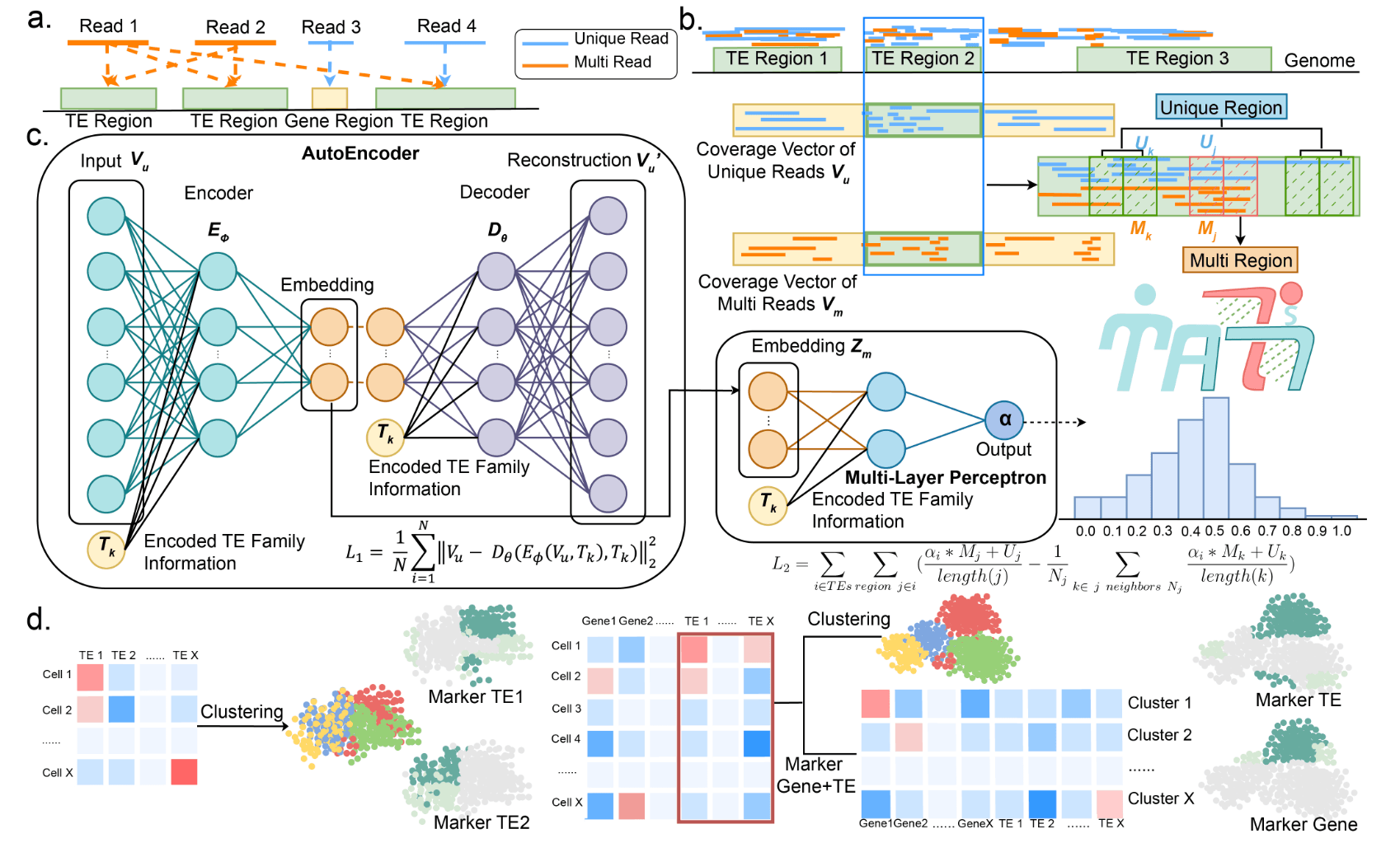
Transposable elements (TEs) are crucial for genetic diversity and gene regulation. Current single-cell quantification methods often align multi-mapping reads to either ‘best-mapped’ or ‘random-mapped’ locations and categorize them at the subfamily levels, overlooking the biological necessity for accurate, locus-specific TE quantification. Moreover, these existing methods are primarily designed for and focused on transcriptomics data, which restricts their adaptability to single-cell data of other modalities.
To address these challenges, here we introduce MATES, a deep-learning approach that accurately allocates multi-mapping reads to specific loci of TEs, utilizing context from adjacent read alignments flanking the TE locus. When applied to diverse single-cell omics datasets, MATES shows improved performance over existing methods, enhancing the accuracy of TE quantification and aiding in the identification of marker TEs for identified cell populations. This development facilitates the exploration of single-cell heterogeneity and gene regulation through the lens of TEs, offering an effective transposon quantification tool for the single-cell genomics community.

Ding Lab
Faculty of Medicine and Health Sciences
Research lab focused on advancing scientific knowledge and innovation.
JD
Jun Ding
Ding Lab · McGill UniversityDigital AssetAvailable
MATES: a deep learning-based model for locus-specific quantification of transposable elements in single cell
Quote on request
Faculty of Medicine and Health Sciences
Biomedical Engineering
McGill University
Transposable elements (TEs) are crucial for genetic diversity and gene regulation. Current single-cell quantification methods often align multi-mapping reads to either ‘best-mapped’ or ‘random-mapped’ locations and categorize them at the subfamily levels, overlooking the biological necessity for accurate, locus-specific TE quantification. Moreover, these existing methods are primarily designed for and focused on transcriptomics data, which restricts their adaptability to single-cell data of other modalities.
To address these challenges, here we introduce MATES, a deep-learning approach that accurately allocates multi-mapping reads to specific loci of TEs, utilizing context from adjacent read alignments flanking the TE locus. When applied to diverse single-cell omics datasets, MATES shows improved performance over existing methods, enhancing the accuracy of TE quantification and aiding in the identification of marker TEs for identified cell populations. This development facilitates the exploration of single-cell heterogeneity and gene regulation through the lens of TEs, offering an effective transposon quantification tool for the single-cell genomics community.
Ding Lab
Faculty of Medicine and Health Sciences
Research lab focused on advancing scientific knowledge and innovation.
JD
Jun Ding
Ding Lab · McGill UniversityYou might also like
Discover more resources that could support your research