ServiceAvailable
Hi-C Analysis
Faculty of Medicine and Health Sciences
Core Facility
McGill University
C3G offers Hi-C analysis to map long-range chromatin interactions, enabling researchers to explore the three-dimensional (3D) structure of the genome. By capturing spatial genome organization, Hi-C helps in understanding topologically associated domains (TADs), chromatin looping, and regulatory element interactions that influence gene expression.
C3G’s Hi-C pipeline includes:
- Preprocessing, involving alignment and filtering of read pairs to generate high-quality contact maps.
- Quality control (QC) following ENCODE standards, ensuring data reliability and reproducibility.
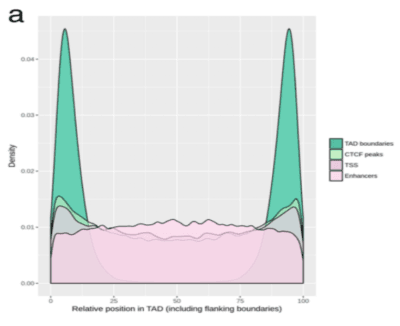
- TAD domain annotation, identifying regions of the genome that interact frequently and contribute to regulatory organization.
- Data visualization and integration, allowing for comparison with other genomic datasets, such as ChIP-Seq, to correlate chromatin interactions with regulatory elements.
C3G’s Hi-C expertise has contributed to integrative genomic studies, such as:
- Lalonde, Simon, et al. “Integrative analysis of vascular endothelial cell genomic features identifies AIDA as a coronary artery disease candidate gene.” Genome Biology 20.1 (2019): 1-13.
By leveraging Hi-C sequencing, researchers can decode chromatin architecture, providing crucial insights into gene regulation, enhancer-promoter interactions, and disease-associated genomic alterations.

Canadian Centre for Computational Genomics (C3G)
Faculty of Medicine and Health Sciences
Shared research facility offering instruments, services and expertise.
GB
Guillaume Bourque
Canadian Centre for Computational Genomics (C3G) · McGill UniversityServiceAvailable
Hi-C Analysis
Faculty of Medicine and Health Sciences
Core Facility
McGill University
C3G offers Hi-C analysis to map long-range chromatin interactions, enabling researchers to explore the three-dimensional (3D) structure of the genome. By capturing spatial genome organization, Hi-C helps in understanding topologically associated domains (TADs), chromatin looping, and regulatory element interactions that influence gene expression.
C3G’s Hi-C pipeline includes:
- Preprocessing, involving alignment and filtering of read pairs to generate high-quality contact maps.
- Quality control (QC) following ENCODE standards, ensuring data reliability and reproducibility.
- TAD domain annotation, identifying regions of the genome that interact frequently and contribute to regulatory organization.
- Data visualization and integration, allowing for comparison with other genomic datasets, such as ChIP-Seq, to correlate chromatin interactions with regulatory elements.
C3G’s Hi-C expertise has contributed to integrative genomic studies, such as:
- Lalonde, Simon, et al. “Integrative analysis of vascular endothelial cell genomic features identifies AIDA as a coronary artery disease candidate gene.” Genome Biology 20.1 (2019): 1-13.
By leveraging Hi-C sequencing, researchers can decode chromatin architecture, providing crucial insights into gene regulation, enhancer-promoter interactions, and disease-associated genomic alterations.
Canadian Centre for Computational Genomics (C3G)
Faculty of Medicine and Health Sciences
Shared research facility offering instruments, services and expertise.
GB
Guillaume Bourque
Canadian Centre for Computational Genomics (C3G) · McGill UniversityYou might also like
Discover more resources that could support your research