
McGill University
McConnell Brain Imaging Centre (BIC)
3801 University St Montreal QC H3A2B4
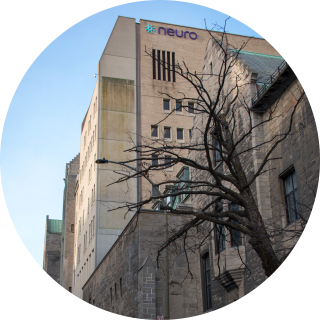
At the forefront of innovation and discovery
Launched in 1984 by the late Dr. Willam Feindel with the support of the McConnell Family Foundation, the BIC is home to 29 world-class researchers, 30 highly qualified personnel and more than 300 trainees and research assistants. It is regarded as one of the top brain imaging research centres in the world. The BIC is based at The Neuro (Montreal Neurological Institute-Hospital).
As members of Canada’s largest neuroimaging facility, BIC’s investigators can employ leading-edge equipment including a 3T magnetic resonance imaging (MRI) system, the first-ever full-body 7T MRI scanner installed in Canada and a 7T preclinical MRI system. In addition, our researchers can use a human high-resolution positron emission tomograph (PET) and a preclinical micro-PET scanner, and will soon have access to the first commercially-available, Health Canada approved, ultra-high resolution (1.3 mm) PET camera in Canada; the latter molecular imaging facilities being supported by a radiochemistry unit capable of synthesizing and producing the world's largest repertoire of radiopharmaceuticals probes. BIC members also have access to a 275-channel CTF magnetoencephalography (MEG) scanner and to other instruments like electroencephalography, electrophysiology and optical imaging recording devices as well as transcranial magnetic stimulation equipment.
A world-renowned neuroimaging and neuroinformatics centre
BIC’s massive data collections are managed by a team of international leaders in neuroinformatics and open science, who are developing publicly-accessible software environments that are suitable for multimodal BIG data analysis, mining, and sharing with institutions around the world.
In addition to neuroimaging and neuroinformatics services provided to BIC Faculty members and more than 90 external principal investigators, numerous clinical trials undertaken at The Neuro rely on the imaging capacity at the BIC, where more than 3800 scans are performed annually.
BIC researchers continue to have notable success forming biomedical spin-off companies that translate data into valuable research and clinical use.
BIC Members are Leading the Way
BIC Members play leadership roles in various scientific initiatives, stimulating collaborations on the provincial, national and international scenes. For example, J. Doyon was the founding director (2008-2019) of the Quebec Bioimaging Network (QBIN).
The BIC is also a hub for major programs such as:
- The Canadian Open Neuroscience Platform (A. Evans, J.-B. Poline)
- The Canadian Consortium on Neurodegeneration and Aging, the Global Brain Consortium (A. Evans)
BIC members also act as leaders for:
- The Organization for Human Brain Mapping, Working Group on Brain Network Nomenclature (N. Spreng)
- The International League Against Epilepsy Neuroimaging Task Force (B. Bernhardt)
- The Canadian Center on Substance Use and Addiction (M. Leyton)
- The Multiple Sclerosis Society of Canada (D. Arnold)
- The International Epilepsy Neuroimaging Data Exchange Initiative and the International Multicentric Artificial Intelligence in Epilepsy Initiative (A. & N. Bernasconi)
- The International Neuroinformatics Coordinating Facility (J.-B. Poline, A. Evans)
From Academic and Clinical Research to Industry
Several BIC members have founded successful spin-off companies implicating the acquisition and analysis of multimodal neuroimaging data, including:
- NeuroRx (D. Arnold)
- Biospective (A. Evans, B. Bedell)
- "True-Positive Medical Devices" (L. Collins, S. Duchesne)
These companies create jobs for highly skilled staff in technology and software development applied to imaging devices and clinical trials.
A Highly Productive Environment
Faculty members of the BIC show an exceptional level of scientific productivity. In the last 5 years, they have published 1,397 scientific papers in leading scientific journals and received more than $104.5M in research funding. In addition, BIC member A. Evans has led a Canada First Research Excellence Fund (CFREF) grant initiative, which was awarded to McGill to support a $84M structuring project (Healthy Brain for Healthy Lives) in neuroscience.
A Broad Impact on Society
The societal impact of the BIC stems from the very nature of the research performed at the Centre, which is at the convergence of clinical and cognitive neuroscience and cutting-edge biomedical engineering and large-scale neuroinformatics. An example is in the development of new imaging biomarkers for a wide spectrum of neurological and neuropsychiatric syndromes including neurodegenerative diseases (for example, Alzheimer's and Parkinson’s), Autistic Spectrum Disorders, and Multiple Sclerosis.
Contact the facility
Talk to the team about your research, access, or a visit.
Find us
McGill University
3801 University St Montreal QC H3A2B4